Wednesday, 4 March 2015

The thinking machines (cultural) revolution

Great art can be interpreted in different ways. One person's satire could easily be another's optimistic science fiction. So it was with this blog post about AI...

As a world we are just beginning to get used to the idea that we can build machines that exceed our mental capacities in certain domains.

Arguably not since the age Neanderthal man have we shared or planet with entities that come close to human beings in terms of logic and reasoning power, combined with ability to express that reasoning to other entities i.e. us.

This TED talk gives a neat idea of the capabilities of certain algorithms in terms of analysing images but also working things out for themselves.


As with all revolutions - agriculture, industry, communication, video gaming, the adoption curve looks a little like this...
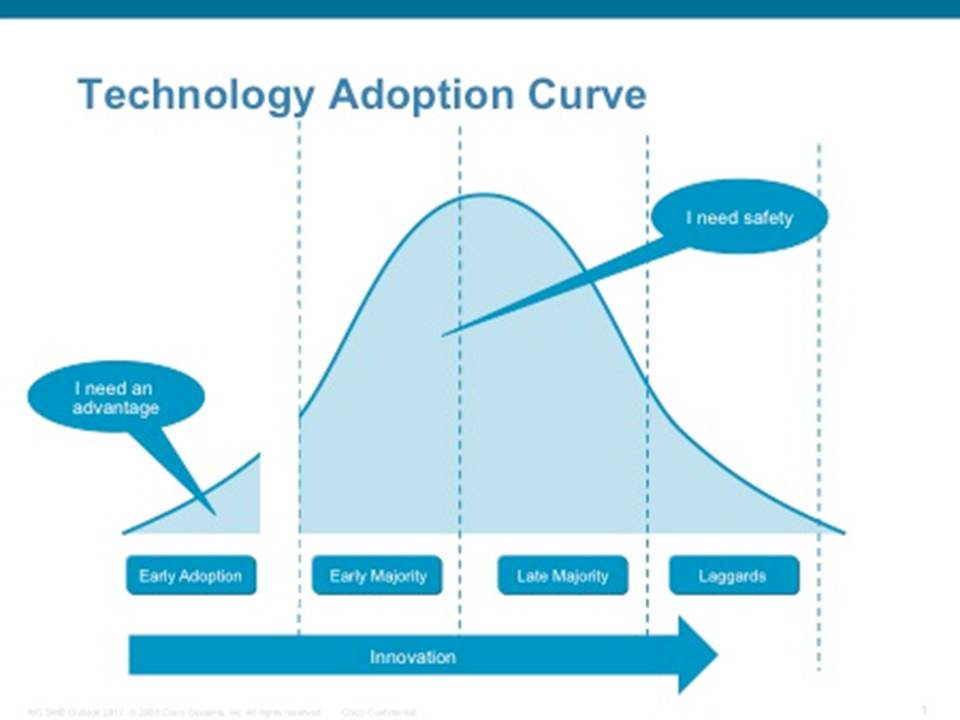


In the case of AI, safety comes in a number of forms, for example:
  • Safety in believing that your domain has not yet been conquered by AI
  • Safety in hoping that nobody develops a nasty form of AI
  • Safety in believing that the technological innovations coming from AI will not be culturally relevant in your particular circle and therefore aren't an interesting topic of conversation
What about the big questions though, will machines ever possess emotional intelligence, be able to make judgement calls, have morals?

Understandably scientific opinion is split on this, probably more in favour of the no camp. That said, to dismiss thinking machines as ripe only for hard data analysis type tasks strikes me as displaying our natural human arrogance. After all as described in this excellent radio 4 documentary AI has already contributed significantly to our philosophical understanding of our place in the world. Machines are also at the forefront of certain areas of modern artistic expression. Back in 1995 I remember laughing at a friend for giving up his engineering degree to study artificial intelligence. These days I am scrambling to catch up...

Thursday, 8 December 2011

Embedding tweets...


Thursday, 16 June 2011

Guardian goes digital first

Today The Guardian announced that it will become a digital-first organisation. This has provoked some great reactions online:

I’d like to congratulate the innovative tech team at the Guardian who have made this transformation possible. I have met a number of them on the London tech meetup circuit and we have spoken recently about their plans to help re-write the organisation like they have re-written their website code. Good luck with it guys!

You can read more on the planned transformation on the press release here

Monday, 22 November 2010

A great day out at #barcampnonprofits

Last Saturday was barcampnonprofits an event bringing together people interested in the social web and how it can help non-profits. Normally an early bird, this wasn't an ordinary Saturday for me and I turned up just in time for the second session.

The talks kicked off for me with a look at social media search tools from my friend Anna. She really managed to keep things simple which was perfect for the audience. For anyone who wants to know more about the tools which are out there for tracking social posts, you can check out http://wiki.kenburbary.com/. I think that socialseek looks cool as far as free tools go. Anna's top tool is Socialmention. Of course, if you want the best in paid social media tracking, look no further than yours truly...

Next up was Val Redchenko with his interesting project kick-off. Hopefully I'm going to help him out testing a machine-learning twitter app which can make recommendations on which tweets to read. It was a lot of fun talking about the capabilities of this type of programme without having to get too worried about the mechanics of the machine-learning process. Any suggestions for a name for our app are more than welcome...

After lunch I was taken on what I will describe as a left-brained charity appeal. Credit goes to Toby Ord for coming up with such an inventive way of promoting charitible causes and doing such a lot of good work. The basic premise is that you use the same method which the NHS uses to define which drugs they should pay for to decide which charity you should support. Turns out that you can buy the most years of quality life for people by sending your money to fight neglected tropical diseases. You can find out more at http://www.givingwhatwecan.org/

Finally the day was topped off by self-confessed minor internet celebrity Ben Walker aka @ihatemornings. He was refreshingly untouched by his notoriety and a good time was had by all.

Thanks to Voice and the other sponsors, this was a really fun event and we made a satifying splash on the interwebs.

Thursday, 18 March 2010

Superpower Nation - I've been experimented upon by the BBC...

This afternoon I went to check out superpower nation. This was a live online/offline forum for people from around the world to come together and talk about anything they liked both by speaking and typing. The language barriers were removed using Google Translate.

The plan was it would seem to avoid prompting conversation and allow it to just happen. You can check out some of the results on

http://www.bbc.co.uk/worldservice/superpower/spn.shtml

The technology certainly did it's job but the absence of any kind of common theme to the conversation led essentially to noise. It also appeared that there were more experimenters than there were guinea pigs.

It would be easy to say this chaos was predictable from experience of human nature, or reading about Douglas Adams' Babel Fish but I would like to be a lot more positive. The more interesting question is where could this technology be used to come to conclusions, make the world a better place? Could micro-events be linked up for the next climate-change negotiation for example? Some form of global debate? I hope such things will evolve organically as we become more used to the technology being available.

Another interesting way to use voice translation would be management training in large global organisations. In my days as a grad student I spent a very rewarding couple of weeks at a graduate training excersise, solving problems working with people from completely different disciplines. An international element would have really put the icing on the cake.

So in conclusion, many thanks to @RoxDog for an intriguing invitation, plenty of hope for the future of Google translate but quite questionable what genuine insight was gained from the Superpower nation experiment.

Perhaps it's just me though, Google and the BBC where pretty happy... Did anyone else go along? What where your thoughts

Sunday, 24 January 2010

Sanitation - a case study for our anti terror operations

Recently, we've been hearing a lot of noise from politicians about the level of risk of a terrorist attack. This interview finally presents a more balanced view on this whole issue.

http://news.bbc.co.uk/1/hi/programmes/world_news_america/8447399.stm

Ted Koppel makes an interesting point saying that President Obama probably did exactly the right thing on Chrismas day by staying with his family in Hawaii. He has then been lured into spending his time doing exactly what Al Quaeda want him to be doing, namely worrying and being seen to worry about Al Quaeda.

This is where the comparison with sanitation comes in. How often does Mr Obama talk about sanitation in America? Not often. Sanitation is sorted, but wherever in the world it is not sorted, lots of people die of cholera etc. as nearly happened in the New Orleans tropical storm.

In the middle ages, sanitation wasn't sorted, people would go into wild speculation about the causes of deaths in cities. I feel we are in a similar situation with terrorism. We are trying hard to understand it, to "be on our guard" or to look like we are doing something about it if we are a politician. In reality, the only people who can do anything about it are secret agents, who by their very nature are secretive. The politicians cant tell us what the secret agents are doing so they have to "change the level of threat" even with no logical evidence that there is a greater threat.

Personally, I am happy for security measures to be increased, in a slow and invisible way. I would have been quite happy for the expenditure being put into Bushes war on terror to all be spent on covert operations, infiltration of terrorist cells, whatever help the Yemeni government needs.

All of these covert operatives would be the silent heroes of the fight against terrorism. Just as the binmen and sanitation engineers are the silent, un-talked about heroes of our streets.

This would leave the rest of us to get on with our lives as normal, and where possible laugh at the stupid people who have nothing better to do than blow themselves up. I can tell you one thing for a fact... I don't think that there is any more chance of me preventing a terrorist attack now than there was when we we at a moderate risk of one occurring. This is to say, nothing that a politician has said about terrorism recently has added anything to our collective common sense. This begs the question why do we need to be told anything? The whole think smacks of the useless protect and survive public information films of the 1970s.


Monday, 16 February 2009

A better shade of grey

When I lived in Durham you could stand on Prebends bridge and see this view of the cathedral. Etched into the stonework are Sir Walter Scott's words

"Grey towers of Durham
Yet well I love thy mixed and massive piles
Half church of God, half castle 'gainst the Scot
And long to roam those venerable aisles
With records stored of deeds long since forgot."

Since moving from a southern-like city in the north to a northern-like town in the south I have been in search of an equivalently evocative poem about Didcot's very own grey towers.


Kit Wright has put forward his attempt to the BBC's verse competition. Check it out here, It starts with

"What vasty thighs outspread to give thee birth," and gets better with lines like

"DIDCOT, thou bugger!"

It's certainly a source of much inspiration, find out more about Didcot through Demontrout's piece here and longtalljohnny's post a while back.

Monday, 19 January 2009

I can't stop thinkin', Thinking 'bout sinkin', Sinkin' down into my bed


It's a bad obsession It's always messin' It's always messin' myyyyyyyy mind....I can't stop thinking 'bout white bears! one more time. Ah but no, actually now I'm more thinking about how much I used to like that song aged 12 without ever reading the lyrics. You can find them here if you're interested.

Anyway, the similarity between white bears and what Axl is calls his mum, is that they are both things I have been trying quite hard NOT to think about this evening. This brings me to a fantastic book, 


You can test one of the wacky experiments in here by sitting in an empty room and trying NOT to think about white bears.

Ha! not as easy as you thought is it

Better still get yourself a copy of Alex Boese's book and see the other tricks that his great conversational writing can play on you.

This experiment is fully documented in

Wegner D. M., Schneider D. J. "Paradoxical effects of thought suppression" Journal of Personality and Social Psychology 53 (1) pp 5-13

Tuesday, 18 November 2008

Online communities - are they the best way to get help and guidance for all life's issues?

I do often think that death and cancer are strange taboos given that so many of us are affected by them directly or indirectly.

A study published this week by Lorraine Buis and coworkers looked at online communities for cancer sufferers (see article here). Apparently cancer sufferers are increasingly being pointed in the direction of these communities to get information and emotional support. The aim was to see if there was a link between the survival rates for the cancer and what people tended to be talking about on the forum.

The results were as follows:
  • Online support communities for high survival rate cancers are more orientated towards emotional support than forums for cancers with low survival rates.
  • Support communities for low survival rate cancers contain more information than online support communities for high survival rate cancers.
The authors hope that this work can help the medical profession make informed decisions when recommending online communities. In this case the families of those who passed away are clearly going to have very different thoughts and priorities to survivors and their loved ones. They will therefore participate in communities in different ways and perhaps not always be providing what their fellow community members might need. I wonder how prevalent this type of discrepancy is in online forums in general?

Saturday, 8 November 2008

Science and Truth

What I've been looking for recently are places to discuss the big issues in science and get them out to the world at large. In my post on CERN I challenged scientists to get their message across in simple and effective terms so as to avoid malicious rumours. David Weinkove is very experienced in these events and brings us a new and interesting format with his brother:

A Talkaoke at the Science Museum this Tuesday at 7 pm

In a recent Essay at LabLit.com he challenges scientists and non-scientists alike to

get off your pedestal and get round the table

It certainly sounds an interesting format, a type of interactive round table talkshow. I'm going to try and grab a ticket as there still seems to be places available.

It's free, at London's Dana centre in the Science Museum, you can find out more here and see the facebook page too.

Parley with a parochial perpetual perceptive popular poster!

Get that?

I have been answering some questions about why I write this thing.

You can look in wonderment at Sylwia Presley's blog to find out more. It's often an interesting site, this week covering the ethics around the US election as well as some great photos and blogging tips.

It's been great to take part through her series of blogger interviews. Other subjects have included Karl, Lolly, Colin, Rich, and the prodigies that are Kid tech Guru and Monik.

Sunday, 2 November 2008

Thursday, 30 October 2008

JET set for an open evening

The UKAEA team, who were at the science event in Didcot emailed me with some dates for public open evenings at my local fusion experiment.

Sounds interesting! Looking back over the power plants I've visited since I was a kid, my CV reads like this:


I've also been to the centre for alternative energy in Wales and seen solar water heating and geothermal energy in use in France.

Fusion can be my next, hopefully ITER, the next big experiment will viably produce power!

Wednesday, 29 October 2008

Greenpeace on fusion: Whatever it is, we're against it

Last weekend was the hugely over-hyped Didcot First Science Event. There I got to see some fun science demonstrations and took away a CD-ROM about Fusion Power. There was also a board for everone to write their opinions on which I thought was good fun.

There was no community interaction on the internet though, this got me thinking about how all the academics need to get their message out better online as was the case for CERN.

Anyway, luckily my CD-ROM drive hadn't packed up from lack of use and I watched the animated slide-show from the guys over at the JET laboratory in Culham. It was reasonably interesting, for me, a trained scientist... I hope the other people who picked it up felt the same. I'd love to share it but I wouldn't want to get a rep for copyright infringement.

Later, I heard from Richard Kemp a fusion scientist, via my brother Stephen. They passed on this great link from theregister.co.uk in which Andrew Orlowski systematically castigates Greenpeace for their suspicion of Fusion Power. It's a powerful and amusing piece, with a great soundbite at the end.

Ranting is fun, and great names like Patrick Moore wouldn't have abandonned Greenpeace unless Orlowski had a point.

But how do we get the good news flowing about science?

Wednesday, 22 October 2008

The BBC turns Presidential Science Advisor

The interesting question asked by this programme was

"Will the next US president embrace science and solve the world's problems like Kenedy did to an extent... Or will we continue down the same track of mistrusting the scientific community and destoying ourselves with our creations."

I didn't manage to catch this programme in the first place, but somehow it is still available... Hopefully the BBC have realised that it's important that this show gets to a wide audience and will remain laissez faire about claiming copyright. Correction: video no longer available, wondered how long it would take.

Wednesday, 15 October 2008

"The monkeys' performance improved markedly with practice"

Hope of a cure for motor neurone problems today. You can read about the story on the Nature News site where I got the title from (with it's nice technorati backlinks widget) and also the BBC.

Moritz, C. T.
, Perlmutter, S. I. & Fetz, E. E. have proved the concept of using signals from a monkey's brain to make it's own paralysed limb move.

I think that the discussion so far has managed expectations really well. Even Luboš Motl's cheeky mock-up of Stephen Hawking as Superman has provoked nothing but measured commentary.

Now let me see, how do I bet on future Nobel Prize winners...

Monday, 13 October 2008

What a great name!

...nice headline too!


You can check out the press release here and get the latest news from Henri Boffin's peers here at the Eurekalert service.

Wednesday, 8 October 2008

Wherever there is fun there's always... SCIENCE!

Scientists say Coke kills sperm and was one of those furphy spermacides during the second world war it's the Coke Side of Pro Life.

Thanks to
TheImaginator: Digg.com, Asianplumb: blogs.theaustralian.news.com.au, candafilm: Digg.com.

As I predicted, the the IG Nobel prizes have provided a veritable minefield of fodder for a Hodgeblodge entry or two, you can read the real story here:
The prize was awarded to two teams of doctors—one team discovered that Coke is an effective spermacide; the other team discovered that it is not.
(improbable.com)

Saturday, 4 October 2008

Schrödinger's LOL cat and my WOMbat in a box

"Schrödinger's cat" was a legendary thought experiment to explain an abstract situation which occurs when you apply the rules for very small particles to life-sized objects..

You are not sure whether the cat is in the box because, even though you put him there, there is a small probability that he is at any point in the universe.

When you look inside the box you will know if he is there or not. But the process of looking inside the box makes the cat "decide" whether it is there or not...

As this was such a legendary thought experiment, Schrödinger's LOL cat just had to already exist, and here it is...

IM IN UR QUANTUM BOX � MAYBE.
more animals
...but surely I'm the first to think up this tenuous link...

From
Schrödinger's LOL cat in a box to my WOMbat in a box

The concept of WOM, (people talking about something and/or recommending it) has some similarities with the concept described by Schrödinger's cat. You stimulate some WOM, so now the WOMbat is growing, consuming the audience in his box. The WOM affects the system within the box, you have some evidence he is doing that, but then as Lolly asks...

funny pictures
moar funny pictures

...what is the end result? How do you know when the WOMbat is successful? You can do a general survey outside the box but you won't be able to ask the people inside the WOMbat's box at the time without affecting the WOMbat. Anyway, doing general surveys is old style market research. I find it somewhat ironic that the proponents of the brave new world of social media marketing resort to this to sell themselves.

Perhaps social media marketers have to be clever and measure not just the number of times a post is read, but also the number of diggs, stumbles, forum thanks and review site reccomends. Rationalising all that could be tough though...

Friday, 3 October 2008

It Rocks


Geology
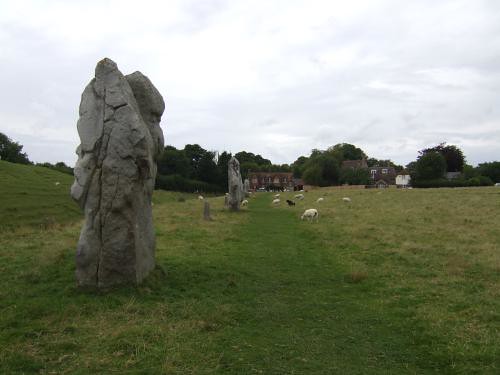
  • Upper - Sarson tertiary sandstone at Avebury stone circle, Wilts.
  • Lower - Devonian old red sandstone on the Brecon Beacons, Powys.
As Wacko Jacko (my Geology teacher) used to say wryly: "Perhaps the more sentimental of you may have stopped to admire the view."